The U.S. West Coast
Aktualisiert: 16. Sept.
From Vancouver to the Mexican Border. Beaches, Cities, Deserts, Mountains, Giant Redwoods, and 49-Degree Heat
Tobias Renggli

Back on the Bike
The two and a half weeks in Vancouver were the first real break since the start of the journey. Nadja came to visit, and we spent most of the time taking things slowly: a few days in the mountains, a small cabin by a lake, then Vancouver. No schedule, no stress, and no problems that needed to be solved immediately.
On the day she left, I took her to the airport, rode back into the city, and set off again. Saying goodbye was not exactly easy, of course, but it felt different from the spring. This time, there was no major expedition waiting for me straight away. Just the West Coast.
Two hours later, I was at the U.S. border. Fingerprints, a photo, lots of questions, then they let me in. Ahead were Seattle, Mount Rainier, Oregon, the redwoods, San Francisco, and eventually the desert.
On the map, it looked like a pretty good route. Just keep heading south.
So Much Beauty
Route planning turned out to be a little less straightforward than that. After Seattle, I could not decide whether to simply keep riding south, make an extra loop through Olympic National Park, or take a detour to Mount Rainier. Several wildfires and poor air quality from all the smoke did not make the decision any easier.
In the end, I chose Mount Rainier. The mountain stands almost alone in the landscape, a glaciated volcano that suddenly appears on the final switchbacks after sunrise and then seems to hover above you wherever you go.
That afternoon, I left the bike behind, hiked up into the Burroughs Mountains, and only made it back with my headlamp on. The sunset was fantastic.
Afterwards, I rode over another pass beneath an endless sky full of stars, reached Tipsoo Lake around half past midnight, pitched the tent, and set my alarm for five.
From there, I continued towards Oregon. The coast looked exactly the way you would imagine it: wide beaches, rocky cliffs, sand dunes, forest, small towns in between, and a lot of ocean.
One day, I had a solid tailwind and rode 280 kilometres. Somewhere along the way, I got the first flat tyre of the entire journey. After Alaska, Canada, ice, gravel, and thousands of kilometres, it was a thumbtack in a driveway in Oregon that finally did it.
Even though I have crossed more than 50 countries by bike, I still struggle to fix a flat tyre.
A few days later, I turned onto the Avenue of the Giants, a quiet road through the redwoods with almost no traffic. Some of the trees are eight metres in diameter, which is surprisingly hard to capture in photos. Still, it became one of my favourite places in the U.S.
That was also where I got another flat tyre.

While I was sitting by the roadside, an older man came past on a fully loaded bike, carrying two tennis rackets and a guitar. He introduced himself as a philosopher and nomad and gave me a detailed explanation of his concept called “Tennissance,” a mix of tennis and Renaissance.
Then he showed me a trick where he played a ball back and forth to himself using two rackets. I did not entirely understand where the revolution was supposed to be, but afterwards he helped me fix the flat.
One Highlight After Another
San Francisco was my first major milestone since Vancouver. Then came Yosemite. Then the Alabama Hills. Then, in theory, Mount Whitney. And after that, Death Valley.
It was all beautiful. Really beautiful. And that slowly became a problem.
Every few days, I reached a place that would probably have been the highlight of a normal trip. The Golden Gate Bridge. Yosemite Valley. Tioga Pass. The rock formations of the Alabama Hills. Then Death Valley. I kept riding, taking photos, flying the drone, filming, looking at the next place, and then moving on again.
In the Alabama Hills, I had even managed to get a permit for Mount Whitney, the highest mountain in the contiguous United States. Technically, I could have climbed it. But I would have had to set off that same night without any sleep. In the days before, I had rarely slept more than four hours, daytime temperatures were above 40 degrees, and I was slowly realising that I did not have to take every detour just because it was possible.
So I skipped Whitney.
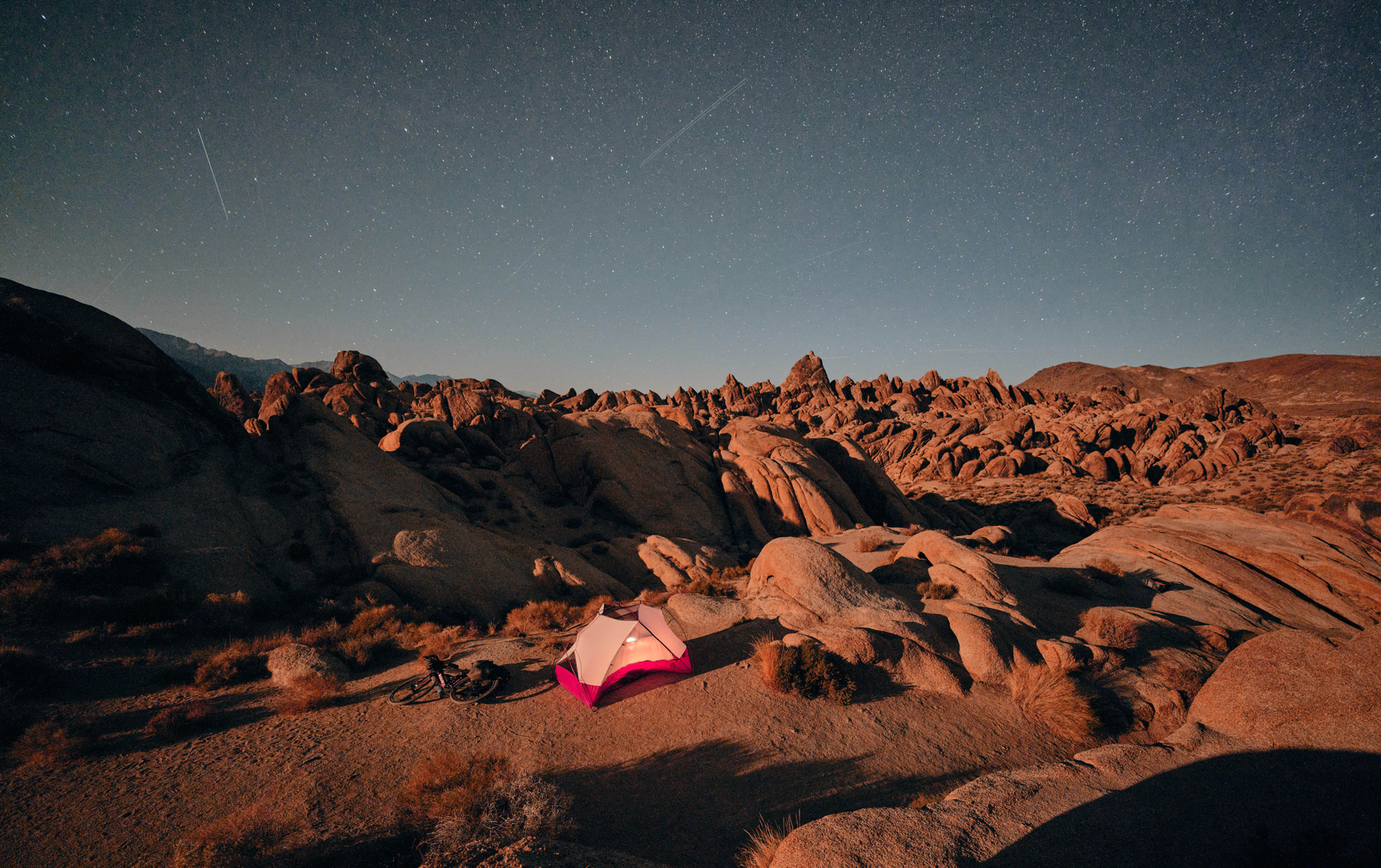
That was not an obvious decision for me. Normally, my mindset is more: if I am already here, I might as well do it. This time, I stayed down and photographed the stars between the rocks until after midnight instead.
120° Farenheit
The next day, I loaded ten litres of water onto the bike in Lone Pine and headed towards Death Valley. First came a climb to a pass at around 1,600 metres, followed by a very long descent. Normally, the airflow from riding cools you down. There, it felt more like a hair dryer.
In Panamint Springs, I sat down in an air-conditioned restaurant, ordered iced tea and fries, and then slept for two hours under a tree. Afterwards, I filled up with another twelve litres of water and asked for ice cubes, which I stuffed into my socks and under my clothes.
That evening, I climbed over the next pass and then descended 1,600 vertical metres into the valley. The sun had long since disappeared, with stars and the moon above me, but it was still well above 40°C. That day, I drank well over ten litres.
The next morning, I rode to Badwater Basin, around 85 metres below sea level. At the parking lot, there is a sign warning people not to stay outside for more than ten minutes in extreme heat. By that point, I had already been in Death Valley for more than 24 hours. A hostile place. And at the same time, one of the most impressive places on the journey so far.
On the way back, I soaked myself completely every few kilometres. A few minutes later, my clothes were dry again. The thermometer showed 49°C — around 120°F. That is getting pretty close to the limit of what feels reasonable on a bike.
During those days, I sometimes just slept on a picnic table, without a tent or sleeping bag. At other times, I rode through the entire night and tried to sleep during the day in an air-conditioned restaurant, curled up on a bench under the table until I got kicked out.

From the Desert to the Hilton
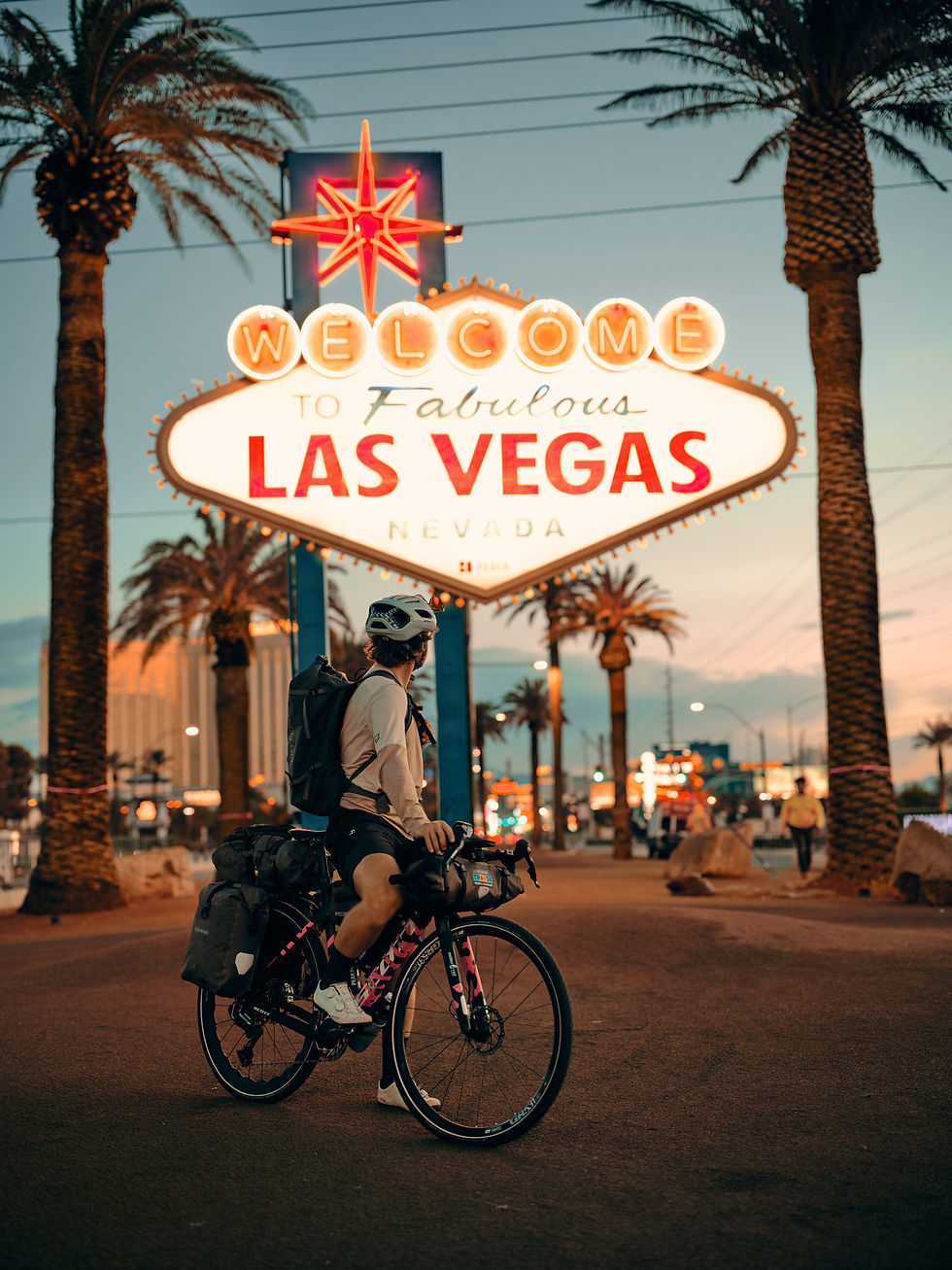
A few hours later, I was in Las Vegas.
I rolled into the Hilton in filthy cycling clothes and took a shower on the 26th floor. Shortly afterwards, we realised Guns N’ Roses were playing in twenty minutes, so we bought tickets on the spot and soon found ourselves in a stadium with tens of thousands of other people.
Earlier that same day, it had been 49°C, I had ice cubes in my socks, and I had slept on a picnic table. A few hours later, there was air conditioning, a hotel room, and a concert.
That was about the moment I realised these weeks were starting to become a little absurd.
Landscape Inflation
Originally, I had planned to ride a big loop through Utah and Arizona from Las Vegas: the Grand Canyon, Monument Valley, Zion, Bryce Canyon, Arches. All iconic places, all within reach, and on the map it almost felt wrong to simply ride past them. But suddenly, I did not feel like doing it anymore.
Within a few weeks, I had seen Mount Rainier, the Oregon coast, the redwoods, San Francisco, Yosemite, the Alabama Hills, and Death Valley. Any one of those places could have been a trip in itself. But when something comes along every two days that would normally be the highlight of a three-week holiday, you eventually start to lose your sense of scale.
I started calling it “landscape inflation.” Not because the landscapes become any less beautiful, but because at some point your own ability to really take them in can no longer keep up. I could have seen more. But I did not want to start simply ticking places off a list.
So I skipped the loop.

Three Days of Almost Nothing
Instead of the Grand Canyon and Zion, I rode only about sixty kilometres south of Las Vegas to Primm and booked a cheap room in a casino hotel in the middle of the desert for three nights.
I went through videos, answered emails, planned Mexico and Central America, and barely moved. After all the days when something had constantly been happening, it was surprisingly nice to experience almost nothing for three days.
Then I continued through the Mojave Desert. There were 150 kilometres between two gas stations. I carried fourteen litres of water and still had a miserable day. Whether I had drunk too little or too much water without enough electrolytes, I still do not know. I had barely eaten anything, at least.
On the final climb, in temperatures above forty degrees, every kilometre felt heavy. At one point, a gust of wind caught my camera tripod, my Sony fell over, and the lens was broken afterwards.
At the end of the stage, I reached Roy’s on Route 66. An older man was sitting there who had ridden from Alaska to Mexico himself around forty years earlier. Because of his accent, I understood very little of what he said. But I did understand one sentence:
“Life is an adventure. There is no reason to die fat and stupid.”
The Last Evening
The next day, Joshua Tree National Park was waiting. I spent six hours hiding from the midday heat in a restaurant in Twentynine Palms and did not start riding until around four. From there, the road climbed for a long time, with almost no traffic. The sun slowly disappeared, and not long afterwards, an orange full moon rose over the desert. I rode through the national park without a shirt, my audiobook still playing. No major sight left to chase, no more detours, no mountain I absolutely had to squeeze in. Just riding.
People often say that if you travel at night, you miss everything. That evening, it was not true. The full moon and the stars were incredible. At around half past midnight, I laid my sleeping mat out on a picnic table at the Salton Sea.
Tomorrow, I will reach Mexico.
But that is another story.
__
Tobias Renggli is travelling from Prudhoe Bay in Alaska to Ushuaia in Patagonia. 35 countries, 35 highest summits, and around 40,000 kilometres under his own power.
Pictures: David Riesbeck / Black Forest Collective


Kommentare